Connect with us:
Blog
Items filtered by date: Saturday, 02 May 2026
Friday, 27 January 2023 00:00
Let the Expert Treat Your Ingrown Toenails

Ingrown toenails can be painful and can make wearing shoes or walking uncomfortable. Seek professional help if you believe you've developed an ingrown toenail and be treated safely.
Tuesday, 24 January 2023 00:00
Understanding the Basics of Hammertoe
Hammertoe is a foot deformity that occurs due to an imbalance in the tendons, muscles, or ligaments that are responsible for holding the toes in their normal position. This condition may be caused by poor footwear, foot structure, trauma, and disease. The most common solution for hammertoe is to relieve the pain by changing your footwear and wearing orthotics. In severe cases, surgery may be required.
The shoes that are most likely to cause hammertoe are high heeled shoes or shoes that are too tight in the toe box. Tight shoes will force your toes to crowd together in a curled position. This position will likely continue when you take your shoes off. Another cause is trauma. When you stub your toe, you are increasing the chance that you will develop hammertoe.
There are risk factors that may make you more likely to develop this condition. Women are more likely to have the condition compared to men, and it is also more likely to appear in those who are older in age.
Many different foot problems can be avoided by wearing shoes that have adjustability, adequate toe room, and low heels. Furthermore, if you want to buy new shoes, you should look to purchase them at the end of the day and make sure you know your correct size. The importance of buying shoes at the end of the day is that your feet swell as the day progresses. You should also ensure that you are wearing your correct size because your shoe size may change as you grow older.
To diagnose someone with hammertoe, your podiatrist will need to conduct a thorough examination of your foot. Your doctor may even order an x-ray to evaluate the bones and joints of your feet and toes.
If you have hammertoe, your podiatrist may recommend that you wear shoes that fit you better along with inserts to place inside them. Additionally, he or she may suggest special exercises for you to perform to stretch your toes. One helpful exercise it to pick up marbles with your feet or crumple a towel with your toes.
Prior to meeting with your podiatrist, it will be helpful to make a list of all the symptoms you are experiencing. You should also make a note of medications you are taking and important personal information about your medical history.
Tuesday, 24 January 2023 00:00
Possible Causes of Hammertoe

A foot deformity known as a hammertoe is caused by an imbalance of the ligament and the muscle in the toe joint. It results in a toe where the middle joint rises up to form a mountain shape. Hammertoes are frequently experienced by women, as the result of wearing high-heeled shoes for long periods of time. The structure of the shoe, especially those with pointy toe boxes and very high heels, puts too much pressure on the toes and can cause joint imbalance. Other causes of hammertoes include high arches, bunions, and arthritis. In some cases, a hammertoe may be the result of an injury, as sudden trauma can cause the muscles and tendons in the toe to slip out of alignment. Flat feet are another cause of hammertoe because those with flat feet rely more on their toes for stability. And some people are genetically inclined to develop hammertoes. Hammertoes are categorized as flexible, semi-rigid, or rigid. Treatment ranging from non-invasive to surgical will depend on the status of the hammertoe. Please contact a podiatrist for an examination and treatment suggestions if you have a hammertoe.
Hammertoes can be a painful condition to live with. For more information, contact the foot specialists of Physicians Footcare . Our doctors will answer any of your foot- and ankle-related questions.
Hammertoe
Hammertoe is a foot deformity that occurs due to an imbalance in the muscles, tendons, or ligaments that normally hold the toe straight. It can be caused by the type of shoes you wear, your foot structure, trauma, and certain disease processes.
Symptoms
- Painful and/or difficult toe movement
- Swelling
- Joint stiffness
- Calluses/Corns
- Physical deformity
Risk Factors
- Age – The risk of hammertoe increases with age
- Sex – Women are more likely to have hammertoe compared to men
- Toe Length – You are more likely to develop hammertoe if your second toe is longer than your big toe
- Certain Diseases – Arthritis and diabetes may make you more likely to develop hammertoe
Treatment
If you have hammertoe, you should change into a more comfortable shoe that provides enough room for your toes. Exercises such as picking up marbles may strengthen and stretch your toe muscles. Nevertheless, it is important to seek assistance from a podiatrist in order to determine the severity of your hammertoe and see which treatment option will work best for you.
If you have any questions, please feel free to contact our offices located in various cities throughout South Carolina and several offices located in Georgia . We offer the newest diagnostic and treatment technologies for all your foot care needs.
Tuesday, 17 January 2023 00:00
Caring for Wounds
Diabetics must be wary of all wounds, regardless of depth or size. Diabetes, a chronic disease in which the body cannot properly use glucose the way it normally would, causes various complications that make wounds difficult to heal. Nerve damage or neuropathy will cause diabetics to have trouble feeling the pain of a blister or cut until the condition has significantly worsened or become infected. A diabetic’s weakened immune system can make even the most minor of wounds easily susceptible to infection. Diabetics are also more prone to developing narrow, clogged arteries, and are therefore more likely to develop wounds.
Wounds should be taken care of immediately after discovery, as even the smallest of wounds can become infected if enough bacteria build up within the wound. To remove dirt, wounds should be first rinsed under running water only. Soap, hydrogen peroxide, or iodine can irritate the injury and should be avoided. To prevent infection, apply antibiotic ointment to the wound and cover it with a bandage. The bandage should be changed daily. The skin around the wound may be cleaned with soap.
To prevent further exacerbation, see a doctor—especially if you have diabetes. Minor skin conditions can become larger problems if not properly inspected. As the wound heals, make sure to avoid applying pressure to the affected area.
Tuesday, 17 January 2023 00:00
Elastic Bandages and the Feet
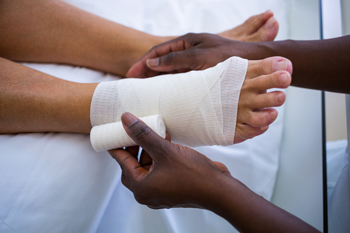
Sometimes when we develop a cut or wound on the human body, it can be beneficial to cover up the wound with a bandage to protect the skin and help it heal. The feet are no different, and sometimes they might benefit from the use of a bandage when wounds develop. To help keep bandages held in the proper place, the use of an elastic bandage on top may be useful. These bandages give extra support to an area of the foot that is injured. Elastic bandages are usually applied to the feet by wrapping or crossing the bandage across the foot, leaving the heel exposed. It can be helpful to refrain from wrapping the elastic bandage too tightly around the foot which may help to prevent cutting off blood circulation to the feet. Elastic bandages are not for everyone. However, if you are interested in elastic bandages and believe they may help you keep your bandages in place, please contact a podiatrist for guidance today.
Wound care is an important part in dealing with diabetes. If you have diabetes and a foot wound or would like more information about wound care for diabetics, consult with the foot specialists from Physicians Footcare . Our doctors will assess your condition and provide you with quality foot and ankle treatment.
What Is Wound Care?
Wound care is the practice of taking proper care of a wound. This can range from the smallest to the largest of wounds. While everyone can benefit from proper wound care, it is much more important for diabetics. Diabetics often suffer from poor blood circulation which causes wounds to heal much slower than they would in a non-diabetic.
What Is the Importance of Wound Care?
While it may not seem apparent with small ulcers on the foot, for diabetics, any size ulcer can become infected. Diabetics often also suffer from neuropathy, or nerve loss. This means they might not even feel when they have an ulcer on their foot. If the wound becomes severely infected, amputation may be necessary. Therefore, it is of the upmost importance to properly care for any and all foot wounds.
How to Care for Wounds
The best way to care for foot wounds is to prevent them. For diabetics, this means daily inspections of the feet for any signs of abnormalities or ulcers. It is also recommended to see a podiatrist several times a year for a foot inspection. If you do have an ulcer, run the wound under water to clear dirt from the wound; then apply antibiotic ointment to the wound and cover with a bandage. Bandages should be changed daily and keeping pressure off the wound is smart. It is advised to see a podiatrist, who can keep an eye on it.
If you have any questions, please feel free to contact our offices located in various cities throughout South Carolina and several offices located in Georgia . We offer the newest diagnostic and treatment technologies for all your foot care needs.
Friday, 13 January 2023 00:00
See A Podiatrist If You Work On Your Feet Regularly

Do you work on your feet all day and find your feet in pain? Don't go to work in pain each day. Your foot pain can be treated, and we can help.
Tuesday, 10 January 2023 00:00
Obesity and the Feet
Obesity is a common problem in American society. Approximately one third of the U.S. population is obese. Obesity is defined as a body mass index greater than 30. Obesity has the power to affect different aspects of the body, and one of the most common problems it causes is foot pain. There have been many studies that found a connection between an increased BMI and foot problems. A simple activity such as walking up a flight of stairs can increase pressure on the ankle by four to six times.
Being overweight causes the body to compensate for the extra weight by changing the way it moves. Consequently, people who struggle with obesity commonly have arch problems in their feet. Obesity causes the arch to break by stretching the ligaments and tendons that hold the bones in the foot together. When the arch lowers, the foot may eventually fall flat. Collapsed foot arches fail to provide adequate shock absorption which eventually leads to foot pain. Other conditions that may be caused by flat feet are pronation, plantar fasciitis, weak ankles, and shin splints.
Foot problems that are caused by obesity may be treated by wearing proper footwear. Proper shoes will allow your feet to have better circulation around the arch and ankle. Additionally, those with obesity often discover that typical heel pain remedies are not effective for them. They will find that their plantar fascia is easily injured, and it is often inflamed. The best way to treat this problem is to implement lifestyle changes. A few good ways to improve your diet are to reduce calories, fill up on fruits and veggies, and to limit sugars.
Custom foot orthotics can prevent foot problems if you’re carrying excess weight or are trying to lose weight. The purpose of orthotics is to provide shock absorption to decrease the amount of stress on the joints to prevent arthritis.
Tuesday, 10 January 2023 00:00
How Obesity Affects the Feet

Extra weight can have a detrimental effect on your feet. Beyond achy and tired feet, problems from obesity can lead to arthritis in the feet. Overweight individuals might notice that their ankles become weaker as their weight increases, and this can lead to increased injuries. With obesity, there is also an increased chance of becoming diabetic, a condition that comes with a host of foot issues. Wearing supportive footwear is important to decrease the amount of strain put on the feet. Losing weight should be the focus of lessening how obesity affects the feet. Changing one’s diet is the most obvious way to help lose weight. Eating healthy foods and those that decrease inflammation is recommended. Diabetics need to make sure that they manage their blood sugar well. Even mild exercise will help in controlling weight. If you are obese and it is affecting your feet, seeing a podiatrist is suggested. This medical professional can help keep your feet as comfortable as possible while weight loss is undertaken.
The more you weigh, the harder your feet must work to support your body. If you’re an obese individual and are concerned about your feet, contact the foot specialists from Physicians Footcare . Our doctors can provide the care you need to keep you pain-free and on your feet.
Obesity and Your Feet
People who are overweight are putting more pressure on their ankles, knees, and hips as well as their feet. This unfortunately can lead to variety of different issues.
Problems & Complications Stemming from Obesity
- When the body is overweight, it tries to compensate by changing the way that it moves. An obese person may lean forward and put extra weight on the wrong part of the foot. This puts unnecessary stress on the feet.
- Obese people are also more likely to develop type II diabetes which is a condition that causes a lot of foot problems. People with diabetes often don’t feel the cuts and sores that they may have on their feet, which can lead to more complicated and severe issues.
- Plantar fasciitis is another foot condition that can be caused by obesity. Plantar fasciitis is an inflammation of the tissue along the bottom of the foot, which causes pain and stiffness while walking and climbing stairs.
If you have any questions, please feel free to contact our offices located in various cities throughout South Carolina and several offices located in Georgia . We offer the newest diagnostic and treatment technologies for all your foot care needs.
Tuesday, 03 January 2023 00:00
How to Treat Heel Spurs
Heel spurs are calcium deposits that cause bone protrusions on the heel bone. Heel spurs are usually associated with plantar fasciitis, which occurs when the plantar fasciitis in the foot becomes inflamed. Typically, heel spurs don’t cause any symptoms. However, they can produce chronic or intermittent heel pain. Those who have had the condition often describe the irritation as a stabbing pain.
There are risk factors that may make you more likely to develop heel spurs. People who have abnormal walking gaits, run and jog on hard surfaces, are obese, or wear poorly fitting shoes are more likely to develop heel spurs.
Fortunately, there are precautions you can take to avoid developing heel spurs. One of the best ways to do this is by wearing well-fitting shoes with shock-absorbent soles. Another preventative technique is to choose running shoes if you plan on running, and walking shoes if you plan on walking. Shoes are made for different activities and it is important to research a shoe before you purchase a pair.
The pain associated with heel spurs often decreases the more you walk. However, a recurrence of pain after an extended period of rest or walking is likely to occur with this condition. Those with severe heel spur pain may opt to go the surgical route for treatment. However, more than 90% of those with the condition get better without surgical treatment. If you have a heel spur and want to know if surgery is right for you, you should go to your podiatrist and he or she will be able to conduct a pre-surgical test or exam to determine if you are an optimal candidate for surgery.
Tuesday, 03 January 2023 00:00
The Shape of Heel Spurs

Heel spurs are bony hooks that can form on the heel bone. They are essentially calcium deposits that may be caused by wearing significantly ill-fitting footwear. It is possible for heel spurs to cause pain. Heel spurs have an interesting shape. They come to almost a pointy end at the tip of the heel spur. This is why the heel spur is said to resemble a kind of hook shape. The hook points towards the plantar fascia in the foot and is relatively small in size compared to the heel bone. It is suggested that an individual who has heel spurs seek medical attention from a podiatrist if the heel spur is causing significant pain or is inhibiting or preventing motion such as walking. Contact a podiatrist today and schedule an appointment if you are struggling with heel spurs.
Heel spurs can be incredibly painful and sometimes may make you unable to participate in physical activities. To get medical care for your heel spurs, contact the foot specialists from Physicians Footcare . Our doctors will do everything possible to treat your condition.
Heels Spurs
Heel spurs are formed by calcium deposits on the back of the foot where the heel is. This can also be caused by small fragments of bone breaking off one section of the foot, attaching onto the back of the foot. Heel spurs can also be bone growth on the back of the foot and may grow in the direction of the arch of the foot.
Older individuals usually suffer from heel spurs and pain sometimes intensifies with age. One of the main condition's spurs are related to is plantar fasciitis.
Pain
The pain associated with spurs is often because of weight placed on the feet. When someone is walking, their entire weight is concentrated on the feet. Bone spurs then have the tendency to affect other bones and tissues around the foot. As the pain continues, the feet will become tender and sensitive over time.
Treatments
There are many ways to treat heel spurs. If one is suffering from heel spurs in conjunction with pain, there are several methods for healing. Medication, surgery, and herbal care are some options.
If you have any questions feel free to contact our offices located in various cities throughout South Carolina and several offices located in Georgia . We offer the latest in diagnostic and treatment technology to meet your needs.
